


QLD MARKET UPDATe
Queensland's electricity market is continuing to shift as more solar and battery capacity comes online. This is changing the way supply is balanced throughout the day, with strong solar generation putting pressure on daytime prices while batteries increasingly support the market later in the day.
In September, the Queensland pricing we have been obtaining for businesses remains more favourable than the levels we have seen previously. We are seeing wholesale pricing around 23% lower than the same period last year. However, the market is becoming increasingly dependent on timing, with the price available for a contract influenced by both current conditions and expectations for future supply.
What we are seeing in the Queensland market:
-
Lower wholesale prices: Around 23% lower than August 2025, with more favourable pricing available to businesses.
-
Solar and batteries growing: Renewables reached 39.1% of generation in August, while battery discharge more than tripled year-on-year.
-
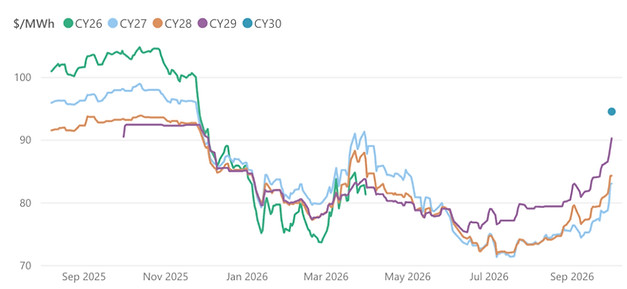
Forward prices firming: After falling through much of 2026, Queensland's forward curve was the most active of any region in August, ticking up rather than holding flat.
-
Network costs rising: 2026–27 tariffs are now flowing through business electricity bills.
-
Changing system needs: Powerlink is reviewing its system-strength plan for Queensland after changes to coal generator retirement timelines altered the underlying need.
The result is a market that can look very different depending on when electricity is being used and when a contract is secured. For Queensland businesses, looking only at an average wholesale price does not necessarily tell the full story.
Futures pricing
Queensland's forward market was the most active mover of any region in August, with prices ticking up rather than holding flat.
In the pricing we have been obtaining for Queensland businesses, forward market pricing has firmed modestly over the past month, though it continues to sit well below the levels seen 12 months ago.
During August:
-
Queensland forward pricing increased 3.3% over the month.
-
Despite this monthly increase, forward pricing remains 16.2% below the state's three-year average.
-
Over the past 12 months, Queensland CY27 futures have fallen by approximately 22%.
This suggests that while the forward market has consolidated at lower levels through most of 2026, Queensland is now showing early signs of repricing in the medium-term (2028) contract, which is worth watching in the months ahead as coal output remains elevated and renewable build timelines are scrutinised.
For businesses approaching a contract renewal, we believe it is important to look beyond today's spot price and consider the pricing currently available for the next contract period.
Network Tariff Changes
The 2026–27 network tariffs have now been in effect for almost three months, with the changes beginning to flow through business electricity bills.
Network charges have risen sharply for Queensland businesses this year. Energex's south-east Queensland network was approved for increases of 12.1% to 13.1% for commercial and industrial customers in the 2026–27 pricing round, among the steepest increases on the east coast.
These increases are influenced by:
-
Higher transmission costs
-
Inflation
-
Revenue adjustments
-
Network investment supporting the transition to renewables
In the bills we are reviewing, network charges continue to be an important part of the overall cost of electricity. This means businesses can still see rising electricity costs even when wholesale prices are falling, particularly where tariff structures or network charges have changed.
Supply Outlook – Generation & Infrastructure
Queensland is continuing to build the infrastructure needed to support a more renewable electricity system and manage the state's shift away from gas and, over time, coal.
Several developments are shaping the state's supply outlook:
-
Renewable generation: QLD's renewable share hit 39.1% in August, up 6.1 points year-on-year, on strong wind (+45.6%) and solar (+21.8%) growth.
-
Growing electricity demand: Data centres, electrification and household batteries are key demand drivers — one proposed Western Downs data centre could eventually draw around a quarter of the state's current daily consumption.
-
More battery capacity: The Supernode project will deliver 780 MW / 3,075 MWh from a single site, among the largest battery developments in the NEM.
-
Peak demand support: QLD battery output nearly tripled year-on-year in August, adding flexibility ahead of summer and easing reliance on gas peakers.
-
Stronger transmission: New projects such as Sybella Creek Solar Farm and BESS are improving access to lower-cost renewable generation across the state.
What This Means for Businesses
From the pricing we are currently obtaining for Queensland, market conditions remain considerably more favourable than a year ago, while batteries and new renewable generation are reducing reliance on gas and changing the way peak demand is supplied. At the same time, network costs have increased sharply in south-east Queensland, and individual tariff structures can have a significant effect on the final electricity bill.
For businesses, more favourable wholesale conditions create an opportunity to review energy contracts, but higher network costs and individual tariff structures can still have a significant impact on the final electricity bill.
If your energy contract is approaching renewal, or you would like to better understand your current position, contact TTEG for a complimentary bill check.


QLD ELECTRICITY FUTURE PRICING CHARt
Queensland System Strength Review Underway
The Queensland electricity grid is undergoing another review of its future system-strength requirements, following changes in the expected timing and operation of some coal-fired generation.
On 9 September, the Australian Energy Regulator (AER) accepted Powerlink's proposal to reassess its previous plans after identifying a material change in circumstances. The original plan included nine synchronous condensers across Central and Southern Queensland, along with contracts for synchronous generation and grid-forming batteries to provide system-strength services.
The review reflects the changing structure of Queensland's electricity market, with more renewable generation and battery storage coming online while the timing and operation of existing coal generation continues to evolve. Powerlink is now required to publish its draft analysis by 19 October 2026, followed by consultation and a final statement by 9 December 2026.
What this means:
Queensland's changing generation mix is creating new requirements for maintaining grid stability. As the network evolves, system-strength and transmission investment can become an increasingly important part of the overall electricity cost structure.


More Battery Storage Planned for Swanbank
Queensland's Swanbank energy precinct is continuing to develop into a major hub for battery storage, with another large battery project progressing through the approvals process.
The proposed Noblevale Battery would provide 180 MW of power and 360 MWh of storage, allowing it to supply electricity for up to two hours at full output. The project is planned for a repurposed mining site in the Swanbank Industrial Area near Ipswich.
The project follows the commissioning of the 250 MW / 500 MWh Swanbank Battery earlier this year. Another proposed project, the 500 MW / 2,000 MWh Blackstone Battery, is also progressing in the same broader area. This concentration of storage projects highlights the growing role batteries are expected to play in Queensland's electricity market.
For the market, additional battery capacity can help absorb surplus electricity during periods of strong renewable generation and supply power when demand increases, particularly later in the day as solar generation falls.
What this means:
More battery storage is changing when electricity is available and how peak demand is managed, making the timing of energy use and contract pricing increasingly important for large electricity users.